Lifting
The Relationship Between Lifting Effects and Shot Count: Criteria for Determining the Optimal Treatment Dose
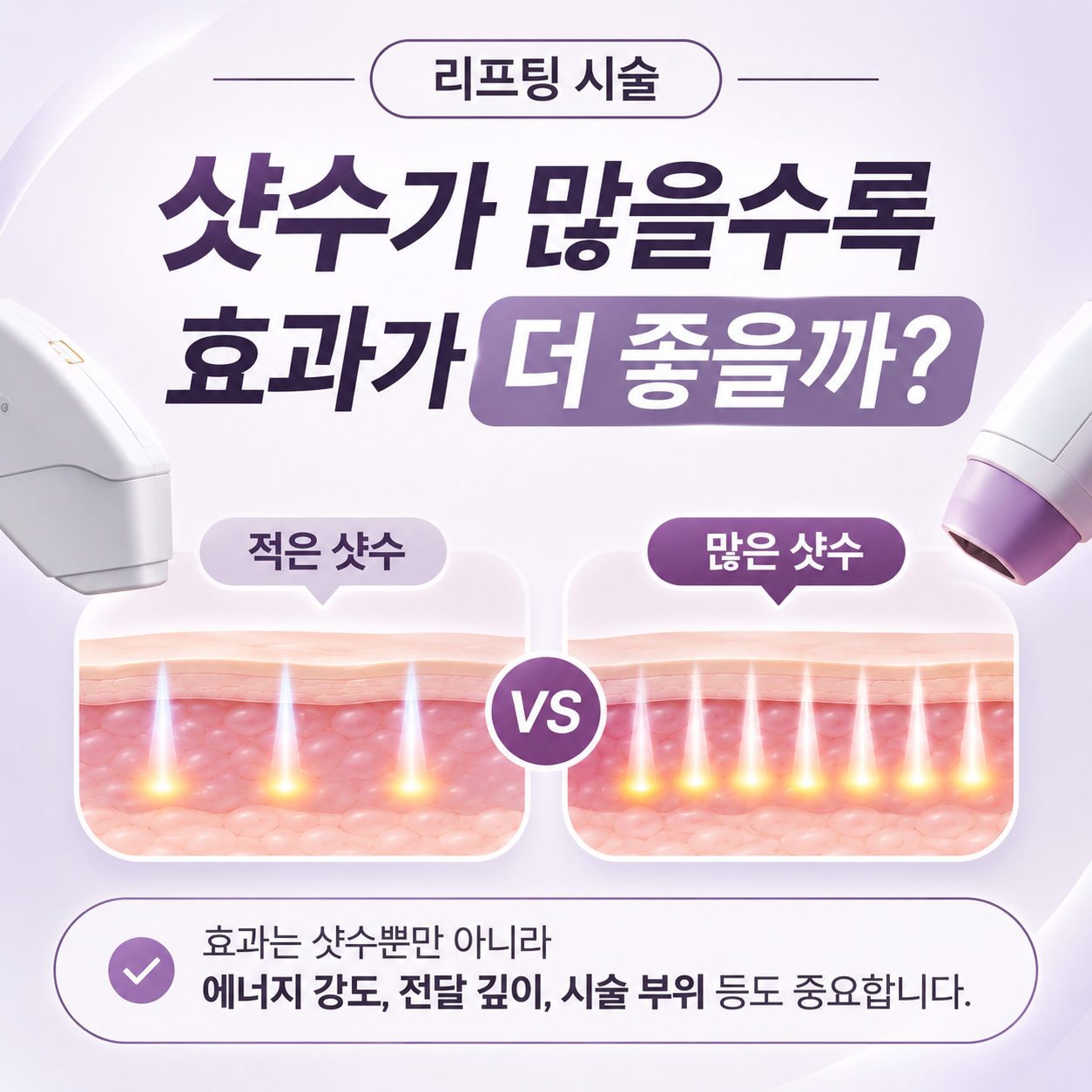
In lifting treatments, a higher shot count does not necessarily guarantee better results. Treatment efficacy is influenced not only by shot count, but also by energy intensity, depth of delivery, irradiation location, skin thickness, and fat distribution. A personalized treatment design that delivers the appropriate energy to the necessary areas is essential.
01. What Does Shot Count Mean in Lifting Treatments?
Shot count refers to the number of times a lifting device delivers energy into the skin.
However, shot count does not carry the exact same meaning across all lifting devices.
Shot Count in Ultrasound Lifting
Micro-focused ultrasound lifting, such as Ultherapy, creates thermal coagulation points within the skin to induce tissue contraction and collagen remodeling.
Treatment dose for Ultherapy is typically expressed in units of "Lines," with multiple thermal coagulation points formed in a single line.
The actual area of energy delivery varies depending on the type of transducer, set depth, energy level, and other factors.
Shot Count in Radiofrequency (RF) Lifting
In RF lifting such as Thermage, the number of times radiofrequency energy is delivered is expressed as shot count or pulse count.
Radiofrequency energy generates heat inside the tissue, inducing collagen contraction and remodeling responses in the process.
The scope of delivered energy is affected by the size of the treatment tip, energy settings, characteristics of the skin tissue, and other variables.
Therefore, 300 lines of ultrasound lifting cannot be directly equated or compared to 300 shots of RF lifting.
02. Does a Higher Shot Count Increase the Lifting Effect?
Within a certain range, increasing the treatment dose allows for treating a wider area or expanding the scope of energy delivery.
However, this does not mean that the lifting effect increases proportionally to the number of shots.
Lifting efficacy is determined by the thermal energy actually delivered to the targeted tissue and the resulting biological response, rather than the simple number of energy delivery cycles.
In particular, because lifting treatments use heat to induce tissue changes, an appropriate level of thermal stimulation is required.
Insufficient energy delivery may not produce the expected tissue response, whereas excessive energy can increase the risk of unnecessary tissue damage and adverse side effects.
In other words, the goal of a lifting treatment is not to apply as many shots as possible, but to deliver the appropriate thermal energy to the necessary tissue.
03. 5 Key Factors That Determine Lifting Efficacy
Energy Intensity
Even with the same shot count, the amount of thermal energy delivered to the tissue varies according to the energy intensity set on the device.
Generally, higher energy intensity may generate stronger thermal stimulation, but the potential for pain and tissue damage must also be taken into consideration.
High energy does not necessarily guarantee superior collagen remodeling or lifting outcomes.
Therefore, appropriate energy settings tailored to the skin condition and treatment goals are required.
Energy Delivery Depth
The skin consists of multiple tissue layers, including the epidermis, dermis, and subcutaneous fat layer, and lifting devices deliver energy in different ways depending on their type.
In particular, ultrasound lifting like Ultherapy focuses energy at different depths depending on the transducer used.
Even with the same shot count, tissue response can differ based on the depth at which the energy is delivered.
Consequently, depth configuration considering the skin thickness and the location of target tissues is crucial.
Shot Distribution and Irradiation Location
Distributing an identical shot count uniformly across the entire face is not always appropriate.
Areas such as the jawline, sub-zygomatic area, anterior cheek, and lateral cheek have different skin and fat layer thicknesses, as well as varying degrees of necessary correction.
Therefore, treatment can be planned to concentrate necessary energy on areas with pronounced tissue sagging, while reducing unnecessary energy delivery to areas lacking volume.
Rather than simply looking at the total shot count, it is essential to examine how energy is distributed across specific areas.
Individual Skin Thickness and Fat Distribution
Skin thickness and subcutaneous fat volume are critical elements when planning a lifting treatment.
Applying identical treatment intensity and shot counts to an individual with thick skin and ample fat versus an individual with thin skin and little subcutaneous fat may not be appropriate.
In particular, when facial fat is sparse, the effect of thermal energy on the fat layer must be carefully considered.
It is important to establish a treatment plan that preserves necessary volume while addressing loss of elasticity and tissue sagging.
Degree and Cause of Skin Laxity
Facial sagging occurs through a combination of reduced skin elasticity, changes in fat compartments, weakening of supportive tissues, and skeletal changes.
Mild skin elasticity loss and severe soft tissue laxity may require different treatment approaches.
Consequently, increasing the shot count alone cannot resolve all forms of sagging.
Particularly in cases of severe laxity or accompanying facial volume loss, other treatment modalities beyond lifting may need to be considered concurrently.
04. Ultherapy vs. Thermage: How Does the Significance of Shot Count Differ?
Classification | Ultherapy | Thermage |
|---|---|---|
Energy Modality | Micro-Focused Ultrasound (MFU) | Monopolar Radiofrequency (RF) |
Treatment Unit | Mainly Lines | Shots or Pulses |
Primary Action | Forms thermal coagulation points at specific depths | Delivers volumetric heat relatively broadly within tissues |
Key Considerations | Irradiation depth, energy, line distribution | Tip size, energy, pulse distribution |
Treatment Design | Target tissue depth and regional distribution | Treatment surface area and regional heat delivery |
Precautions | Consideration of fat layers and neural structures | Consideration of excessive heat accumulation and skin damage |
Ultherapy features real-time ultrasound imaging, allowing energy delivery while verifying tissue depth and structure.
Therefore, rather than simply increasing line counts, it is essential to verify the target tissue and deliver energy to the appropriate depth.
In Thermage, the treatment area covered in a single energy delivery can vary depending on the size of the treatment tip.
Even when treating identical areas, the required pulse count can vary depending on the tip used, making it difficult to directly compare treatment volume by shot count alone.
Particularly with Thermage, numbers such as 600 shots or 900 shots sometimes represent the maximum pulse capacity configured for the treatment tip.
Therefore, it is necessary to distinguish tip capacity from the actual shots delivered and the energy settings utilized in treatment.
05. What Problems Can Occur If the Shot Count Is Excessive?
While lifting treatments induce tissue changes through appropriate thermal stimulation, excessive energy delivery can lead to adverse side effects.
Fat Atrophy and Cheek Hollows
When ultrasound or radiofrequency energy affects the fat layer, there is potential for fat tissue atrophy to occur.
In particular, individuals with naturally low facial fat or hollow sub-zygomatic areas may show pronounced contour differences even with minimal volume changes.
If fat atrophy develops, cheek hollows or facial contour irregularities can become prominent, requiring caution regarding treatment areas and energy settings.
However, cheek hollows are rarely reported adverse reactions, and fat atrophy cannot be assumed to occur solely because the shot count was high.
Thermal Damage and Burns
Delivering excessive thermal energy to a specific area can cause unnecessary damage to skin tissue.
Depending on the treatment technique and energy settings, adverse reactions such as severe pain, blisters, burns, and pigmentary changes may occur.
In particular, when energy is repeatedly delivered to the same site, cumulative thermal stimulation must be carefully monitored.
Sensory Changes and Nerve Damage
Numerous sensory and motor nerves are distributed across the face.
If energy is delivered to an improper location or depth, temporary sensory changes or, rarely, nerve injury may occur.
Therefore, treatment must be performed with careful consideration of facial anatomy and high-risk zones.
Unnecessary Tissue Damage
Skin tissue undergoes a process of recovery and remodeling following a certain threshold of thermal stimulation.
Delivering energy beyond what is necessary does not continuously increase collagen synthesis.
Rather, excessive heat stimulation can increase tissue damage and recovery burden, requiring treatments to be planned at levels appropriate for the individual's skin condition.
06. What Criteria Determine the Appropriate Shot Count?
There is no single standardized shot count that applies universally to every individual in lifting treatments.
The appropriate treatment dose is determined through a comprehensive evaluation of the following factors:
Evaluation Category | Items to Assess |
|---|---|
Facial Contours | Structural characteristics of the zygoma, jawline, cheeks, etc. |
Skin Thickness | Thickness of dermis and subcutaneous fat layer by region |
Degree of Sagging | Soft tissue laxity across facial and cervical areas |
Fat Distribution | Areas requiring volume preservation vs. areas with excess fat |
Treatment History | Previous lifting, fillers, thread lifting, or surgical procedures |
Treatment Goals | Jawline contouring, skin tightening, fine wrinkle reduction, etc. |
For example, if jawline sagging is the primary concern, a lifting plan tailored specifically to that area is warranted.
Conversely, for patients with low facial fat and pre-existing cheek hollows, plans should focus on minimizing unnecessary thermal stimulation to the adipose layer.
Thus, even if the total shot count is identical, actual treatment areas and energy distribution strategies can vary considerably by individual.
07. Does a Low Shot Count Result in Insufficient Efficacy?
One cannot conclude that efficacy will be insufficient solely because the shot count is low.
When treating narrow areas or addressing only specific targeted sites, fewer shots may be required compared to treating the entire face.
On the other hand, addressing a broad area or multiple tissue depths may necessitate a relatively higher shot count.
What matters most is not the total shot count, but whether sufficient and appropriate energy has been delivered to the targeted treatment area.
However, using an excessively low shot count relative to the required treatment dose may leave the coverage insufficient, potentially leading to underwhelming results.
Ultimately, shots should be neither unconditionally numerous nor minimal, but rather tailored accurately to the treatment objectives.
08. Checklist Before Undergoing Lifting Treatment
When deciding on a lifting treatment, it is advisable to consider the following aspects in addition to shot count and pricing:
Pre-Treatment Checklist
Whether an evaluation of your personal skin thickness and fat distribution was performed
Whether areas needing improvement were differentiated from areas requiring volume preservation
Whether the chosen treatment device and tip specifications are appropriate
Whether regional shot counts and energy delivery depths have been planned
Whether clear explanations regarding expected outcomes and potential side effects were provided
Whether prior treatment history and appropriate treatment intervals were taken into account
Furthermore, even when using identical equipment, the position and scope of energy delivery can vary depending on the practitioner's anatomical understanding and treatment planning.
Therefore, rather than evaluating treatments solely by shot count, it is crucial to review personalized diagnostic evaluations and treatment plans comprehensively.
09. The Key Determinant of Lifting Results Is Proper Treatment Design, Not Shot Count.
A lifting treatment is not simply about delivering vast amounts of energy to the skin.
It is a meticulous process of applying appropriate energy to the necessary areas, taking into account skin thickness, fat distribution, the degree of aging, and soft tissue laxity.
While higher shot counts may enable broader treatment coverage, efficacy does not necessarily increase proportionally.
Conversely, delivering less energy than the required treatment dose may make it difficult to achieve satisfactory improvement.
Therefore, the essential element in lifting treatments is not the maximum shot count, but establishing the appropriate shot count, energy intensity, delivery depth, and irradiation locations tailored to the individual's facial structure and skin condition.
To ensure both treatment efficacy and safety, establishing a personalized treatment plan based on thorough medical examination and consultation is essential.
Go to Official TING CLINIC Blog
This content is for general medical information and does not replace diagnosis or treatment. Treatment effects and side effects may vary, so consult a medical professional.