Lifting
Why Receive Ultherapy and Thermage Together?
Ultherapy uses microfocused ultrasound to form thermal coagulation points at specific tissue depths, while Thermage utilizes monopolar radiofrequency to deliver heat across a relatively broad area of tissue. Combining these two treatments can be considered when aiming to improve both skin sagging and reduced elasticity, but it is not always superior to a single standalone treatment. To ensure treatment effectiveness and safety, an individualized treatment plan that accounts for facial anatomical structure, skin thickness, and fat distribution is essential.
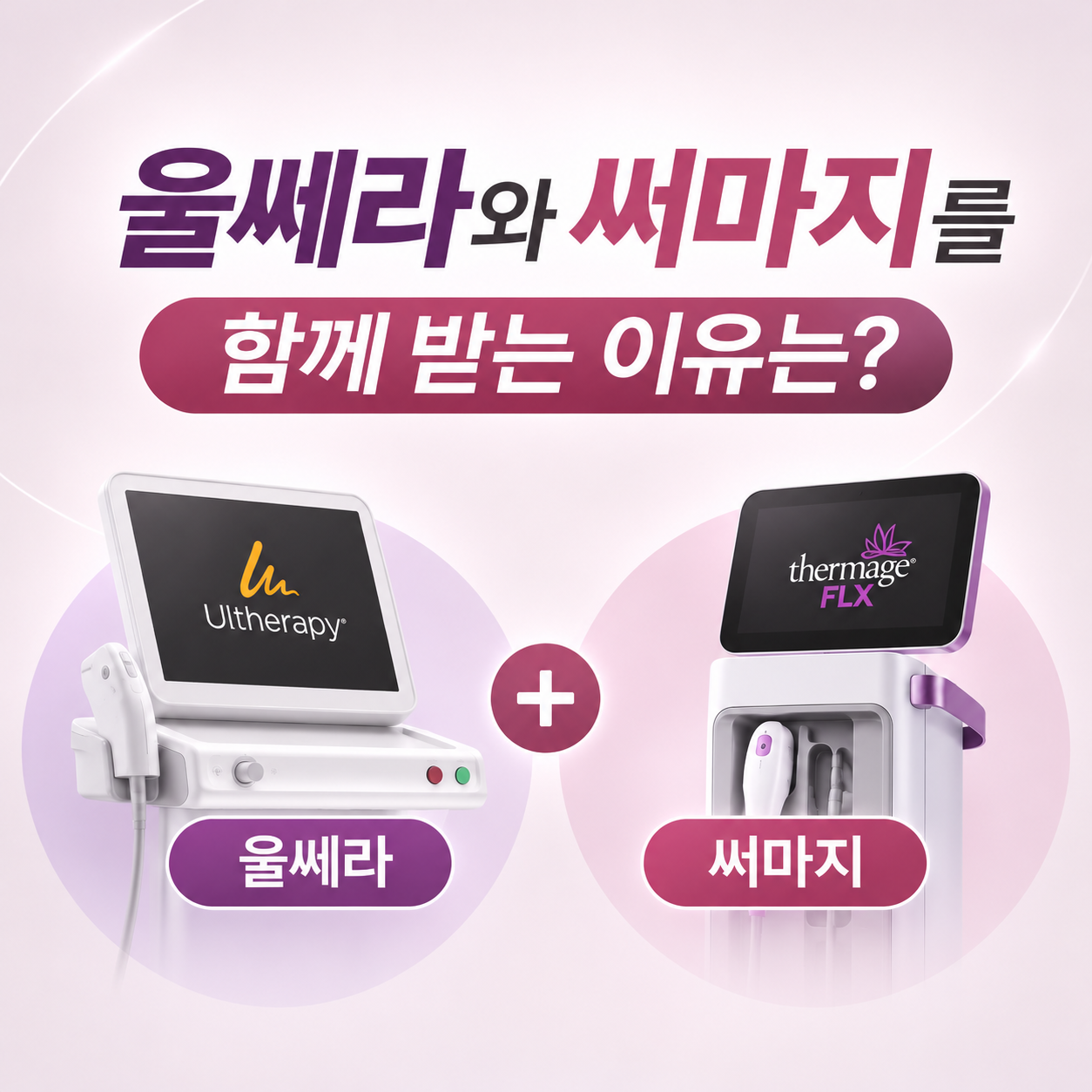
Ultherapy uses microfocused ultrasound to form thermal coagulation points at specific tissue depths, while Thermage utilizes monopolar radiofrequency to deliver heat across a relatively broad area of tissue.
Combining these two treatments can be considered when aiming to improve both skin sagging and reduced elasticity, but it is not always superior to a single standalone treatment.
To ensure treatment effectiveness and safety, an individualized treatment plan that accounts for facial anatomical structure, skin thickness, and fat distribution is essential.
01. Working Principles of Ultherapy and Thermage
Ultherapy — Lifting Using Focused Ultrasound
Ultherapy is a treatment that uses microfocused ultrasound (MFU) to create thermal coagulation points at specific depths within the skin.
Ultrasound energy is concentrated at the set depth, which induces tissue thermal contraction and subsequent collagen remodeling.
The key characteristics of Ultherapy include:
Energy type: Microfocused ultrasound (MFU)
Energy delivery: Concentrated thermal coagulation points at specific depths
Primary target areas: Dermis, subcutaneous tissue, and deep soft tissues including the superficial muscular aponeurotic system (SMAS)
Main objective: Improvement of skin and soft tissue sagging and tissue lifting
Technical feature: Real-time visualization of internal skin tissue using ultrasound imaging during treatment
Transducers targeting different depths—typically 1.5 mm, 3.0 mm, and 4.5 mm—are used, and the actual application depth is determined based on anatomical characteristics of each area.
Ultherapy is particularly utilized to lift lax tissues around the eyebrows, submental area (under the chin), and neck.
Thermage — Tightening Using Monopolar Radiofrequency
Thermage is a treatment that generates heat within the skin using monopolar radiofrequency (RF) energy.
As radiofrequency energy passes through tissue, the resulting resistive heat induces contraction of existing collagen and subsequent remodeling.
The key characteristics of Thermage include:
Energy type: Monopolar radiofrequency (RF)
Energy delivery: Volumetric heat delivery across a relatively broad area of the dermis and subcutaneous tissue
Primary target areas: Centered on the dermis and extending into surrounding subcutaneous tissue
Main objective: Improving skin elasticity, softening fine lines, and skin tightening
Technical feature: Delivers thermal energy into internal tissues while cooling the skin surface
Thermage is used to enhance tissue tension and restore skin elasticity when skin elasticity declines or fine wrinkles appear.
Because both devices can influence multiple tissue layers, simply categorizing Ultherapy as acting only on deep layers and Thermage only on superficial layers is an oversimplification.
02. Key Differences Between Ultherapy and Thermage
Category | Ultherapy | Thermage |
|---|---|---|
Energy | Microfocused ultrasound | Monopolar radiofrequency |
Heat Delivery Method | Energy focused at specific depths | Thermal energy delivered over a broad area |
Primary Treatment Objective | Tissue lifting | Skin tightening |
Primary Concerns Addressed | Sagging skin and soft tissues | Reduced skin elasticity, fine lines |
Collagen Response | Thermal contraction and remodeling | Thermal contraction and remodeling |
Treatment Results | Gradual changes over several months | Gradual changes over several months |
03. Why Combine Ultherapy and Thermage?
Both skin sagging and reduced elasticity can be addressed simultaneously.
Skin aging involves more than simply downward sagging of the skin.
As aging progresses, changes in collagen and elastic fibers, shifts in facial fat compartments, and weakening of supporting tissue structures occur concurrently.
Consequently, reduced skin elasticity and soft tissue laxity often appear at the same time.
Ultherapy induces lifting by delivering concentrated thermal energy to specific tissue depths, whereas Thermage promotes skin tightening by delivering heat broadly across tissue.
Because their mechanisms of action differ, combination treatment may be considered when both sagging and loss of skin elasticity are present.
Different thermal energy delivery patterns can be leveraged.
While both Ultherapy and Thermage use heat, the way heat distributes within tissues differs.
Conceptual Diagram of Energy Delivery Patterns
Actual tissue responses and depth of energy delivery vary depending on device parameters and individual anatomical structures.
Ultherapy: Forms localized thermal coagulation points to induce tissue contraction and collagen remodeling.
Thermage: Produces volumetric heat distribution within tissue to promote collagen contraction and improved skin elasticity.
Therefore, combination therapy is one approach to complex skin aging that takes advantage of these distinct energy delivery profiles.
Treatment can be tailored according to specific facial regions.
Skin thickness, subcutaneous fat volume, and the degree of tissue sagging differ across various areas of the face.
For example, soft tissue sagging may be prominent along the jawline, while reduced skin elasticity may predominate on the mid-cheeks.
In such cases, distinguishing targeted areas and treatment goals is more appropriate than applying uniform energy across the entire face.
Decisions regarding whether to combine Ultherapy and Thermage can be made on the basis of this evaluation.
It provides an approach to multifaceted skin concerns that a single modality may not fully address.
If skin laxity is the primary issue, a lifting-focused treatment may be considered; if loss of skin elasticity is primary, a tightening-focused treatment may be selected.
When both concerns are combined, however, achieving desired improvements through a single approach alone may be difficult.
In these instances, combining the two treatments allows complementary coverage of clinical objectives.
However, the extent of combined efficacy and safety varies across individual clinical studies and patient characteristics, and combination treatment is not necessary for everyone.
04. Skin Conditions Suitable for Considering Combination Treatment
Skin Condition | Treatment Considerations |
|---|---|
Sagging along jawline and neck | Evaluate for tissue lifting with Ultherapy |
Generalized loss of facial elasticity | Evaluate for tightening with Thermage |
Coexisting skin sagging and fine lines | Review suitability for combination treatment |
Thin skin with sparse subcutaneous fat | Exercise caution regarding thermal energy area and intensity |
Hollowing beneath cheekbones or in lateral cheeks | Require treatment design that preserves existing volume |
Severe skin sagging | Evaluate limitations of non-invasive procedures and consider other modalities |
05. Precautions When Receiving Ultherapy and Thermage Together
Excessive thermal energy delivery must be avoided.
Because both treatments utilize heat, the cumulative thermal stimulus must be carefully considered during combination protocols.
Excessive energy delivery or repeated passes over the same localized area can increase the risk of tissue damage.
Accordingly, treatment areas, energy intensity, shot count, and procedural order must be comprehensively established.
The risk of cheek hollowing and fat atrophy must be taken into account.
If ultrasound or radiofrequency energy affects the adipose layer, localized fat atrophy or changes in facial contour can occur.
Caution is especially required in patients with minimal cheek volume or insufficient subzygomatic fat, as preexisting hollows may appear more pronounced.
Evaluating fat layer thickness and facial anatomical features is essential when planning the treatment zone.
Combination treatment does not necessarily guarantee superior outcomes.
A 2025 study in Dermatologic Surgery involving 24 Korean adults observed improvement in wrinkles when monopolar radiofrequency and focused ultrasound were administered sequentially.
In that study, performing radiofrequency first showed slightly greater wrinkle improvement; however, these findings reflect a small-sample investigation.
It is therefore difficult to conclude definitively that a particular sequence is superior for all patients.
Furthermore, the findings from this study cannot be generalized uniformly across every combination of Ultherapy and Thermage devices.
Individual health status and previous aesthetic history must be verified.
The following items should be reviewed prior to treatment:
Presence of implanted electronic devices, such as cardiac pacemakers
Presence of active infection or inflammation in the treatment area
History of fillers, thread lifting, or facial surgery
History of sensory abnormalities or nerve injury
Pregnancy status and other underlying medical conditions
In particular, Thermage may be contraindicated in patients with implanted electronic medical devices, requiring advance confirmation with the medical team.
06. When Do Treatment Effects Become Visible?
With both Ultherapy and Thermage, early changes visible immediately post-treatment should be distinguished from progressive changes developing over time.
Category | Ultherapy | Thermage |
|---|---|---|
Early Changes | Changes secondary to partial tissue contraction | Initial tightening changes possible |
Progressive Improvement | Predominantly observed over 2 to 3 months | Predominantly observed over 2 to 6 months |
Main Changes | Tissue lifting and elasticity improvement | Skin elasticity and fine wrinkle improvement |
Factors Affecting Outcomes | Degree of sagging, skin thickness, treatment settings | Skin condition, treatment coverage, energy settings |
For both treatments, visible changes develop progressively as collagen remodeling takes place.
However, the onset and duration of results involve individual differences, and final efficacy cannot be judged solely by immediate post-treatment changes.
07. Potential Post-Treatment Adverse Effects
Although Ultherapy and Thermage are non-invasive treatments, side effects may still occur.
Relatively Common Reactions
Temporary erythema and swelling
Pain or tenderness in the treatment area
Sensation of heat in the skin
Transient sensory changes
Rare Adverse Events
Burns and blister formation
Surface irregularities of the skin
Cheek hollowing from fat atrophy
Sensory or motor disturbances secondary to nerve injury
Pigmentary alterations and scarring
If severe pain, blistering, changes in skin discoloration, persistent sensory abnormalities, or abnormal facial muscle movement occur after treatment, evaluation by a medical team is required.
When planning combination therapy, these potential risks must be evaluated alongside anticipated benefits.
08. In Combination Treatment, an Individualized Treatment Plan Is Most Critical
Ultherapy and Thermage employ different energy delivery mechanisms, allowing them to be considered complementary modalities when skin sagging and loss of elasticity coexist.
However, facial aging involves changes not only in skin elasticity, but also in fat compartments, musculature, ligaments, and skeletal framework.
Consequently, the same procedural combination is not appropriate for every patient.
When deciding on combination treatment, thorough evaluation of skin thickness, soft tissue laxity, facial fat distribution, and past procedure history is essential.
The purpose of combining Ultherapy and Thermage is not merely stacking two energy sources, but inducing lifting and tightening through an approach tailored to the individual's skin condition.
Visit the Official TING CLINIC Blog
This content is for general medical information and does not replace diagnosis or treatment. Treatment effects and side effects may vary, so consult a medical professional.