Booster
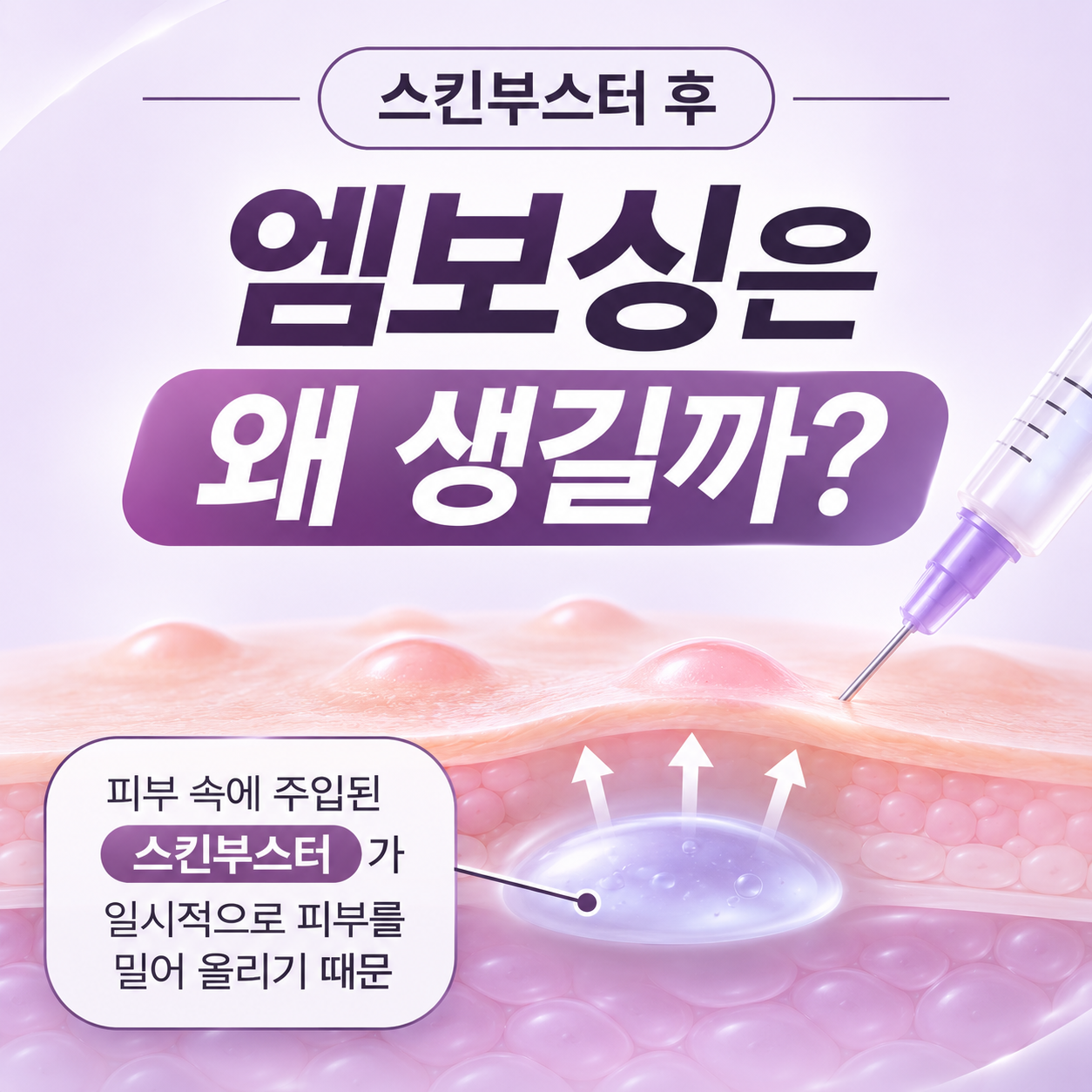
Why Does Embossing Occur After Skin Booster Injections?
When a skin booster is injected, a certain volume of the product temporarily remains in the area, potentially pushing up the surrounding tissue. In particular, because the dermal layer of the skin is relatively dense, even a small amount of product can cause raised bumps on the skin surface. This change does not necessarily indicate a side effect; it is a temporary reaction that can occur during the process of injecting product into the superficial layers of the skin. However, if embossing persists for an extended period or is accompanied by pain, redness, or heat, an evaluation for other potential causes is necessary.
What Is Skin Booster Embossing?
Embossing refers to a phenomenon where the injection site rises into small bumps when a skin booster is injected into relatively superficial layers of the skin.
Medically, it may be observed as a form similar to small papules or wheals appearing on the skin surface.
When a skin booster is injected, a certain volume of the product temporarily remains in the area, potentially pushing up the surrounding tissue.
In particular, because the dermal layer of the skin is relatively dense, even a small amount of product can cause raised bumps on the skin surface.
This change does not necessarily indicate a side effect; it is a temporary reaction that can occur during the process of injecting product into the superficial layers of the skin.
However, if embossing persists for an extended period or is accompanied by pain, redness, or heat, an evaluation for other potential causes is necessary.
5 Causes of Embossing After Skin Booster Injections
1. Volume of the product injected into the skin
The most direct cause of embossing is the volume of the product injected within the skin.
When product is injected into the skin using a syringe, a temporary space is formed at that location, and the injected substance pushes up the surrounding tissue.
In particular, techniques that repeatedly inject small amounts into the dermal layer can form small bumps at each injection point.
As the product subsequently disperses into the surrounding tissue and injection-related swelling subsides, the protrusions on the skin surface can also gradually diminish.
2. Viscosity and physical properties of the product
Skin boosters vary by product in terms of ingredients, viscosity, and physical characteristics within the tissue.
For example, products containing polynucleotide (PN) or hyaluronic acid-based formulations may exhibit differences in tissue distribution patterns depending on their formulation.
Products with relatively high viscosity or properties that cause them to remain at the injection site for a certain period may produce more pronounced elevations on the skin surface.
However, a higher viscosity does not necessarily mean that embossing will be severe or long-lasting.
Other factors, such as injection depth, injection volume, and skin thickness, also play a role.
3. Injection depth of the product
The skin is composed of the epidermis, dermis, and subcutaneous tissue.
When a skin booster is injected into the relatively shallow dermis, the distance between the skin surface and the product decreases, which can make embossing more prominent.
In contrast, when injected into a deeper layer, surface elevation may be less noticeable even when using the same volume.
However, injecting deeply merely to reduce embossing is not advisable.
Recommended injection depths vary according to the ingredients and product characteristics of each skin booster, so a depth appropriate for the treatment objective must be selected.
4. Differences in skin thickness by area
The thickness of the skin and the structure of soft tissue differ across various areas of the face.
In particular, in areas with thin skin such as around the eyes, surface changes can be observed relatively easily even with a small amount of product.
In contrast, in areas where the skin is relatively thick, the appearance of embossing may differ even with the same amount of product.
Therefore, it is necessary to adjust the injection volume and depth in consideration of the skin thickness and tissue characteristics of the treatment area.
5. Temporary swelling and inflammatory response from injections
Embossing can occur not only due to the volume of the injected product itself, but also as a result of tissue reactions arising during the injection process.
When a needle passes through the skin, micro-tissue damage can trigger a localized inflammatory response.
During this process, temporary swelling, redness, and tenderness may occur, and embossing may become more noticeable as surrounding tissue swells.
Most of these reactions gradually subside during the recovery process.
Does Embossing Vary Depending on the Type of Skin Booster?
Because ingredients and physical properties vary among skin booster products, the skin reactions observed after injection can also differ.
1. Rejuran
Rejuran is a product that utilizes polynucleotide (PN) as its primary ingredient.
When treated by injecting small amounts into the dermal layer, embossing may appear at each injection point.
Such changes may be particularly noticeable in areas where the skin is thin.
While mostly temporary, there are individual differences in the recovery period.
2. Hyaluronic Acid Skin Boosters
Hyaluronic acid is a substance with water-binding properties.
Localized elevation or swelling may occur depending on the volume of the injected hyaluronic acid formulation, its water-binding characteristics, and the injection depth.
Since viscosity and tissue distribution characteristics vary by product, not all hyaluronic acid skin boosters produce identical embossing.
3. Juvelook
Juvelook is a collagen booster based on PDLLA and hyaluronic acid.
Immediately after injection, the skin surface may temporarily rise due to the volume of the product or localized swelling.
However, with particulate products such as Juvelook, it is important to distinguish typical embossing from persistent nodules.
If firm bumps develop long after the treatment or if elevations at the injection site persist, the possibility of nodules should be evaluated.
Does More Severe Embossing Mean Better Skin Booster Results?
Some individuals believe that if embossing appears prominently after a skin booster treatment, a sufficient amount of product has been injected.
However, the size or number of embossing bumps is not a direct criterion for evaluating the effectiveness of a skin booster.
Embossing is a phenomenon caused by the volume of injected product, injection depth, physical properties of the product, and tissue swelling.
On the other hand, the therapeutic effect of a skin booster relates to the characteristics of the ingredients used, appropriate delivery within the tissue, skin condition, and subsequent biological responses.
Therefore, more embossing does not indicate that the product is working more effectively, nor does minimal embossing imply insufficient effectiveness.
The appropriateness of the treatment should be evaluated comprehensively based on the product used, the injection technique, and the treatment goals, rather than the degree of embossing.
Precautions When Embossing Occurs
If embossing occurs after a skin booster treatment, it is important to minimize unnecessary irritation and care for the treatment area so it can recover.
1. Do not press hard on or massage the treatment area.
Repeatedly pressing or rubbing the injection site to eliminate embossing can increase skin irritation.
Post-treatment massage guidelines may vary depending on the product, so you should always follow the instructions of the treating medical team.
2. Minimize skin irritation immediately after treatment.
Avoid excessive friction or strong pressure, and follow the medical team's guidance regarding when you may wash your face or apply makeup.
3. Avoid exposure to excessive heat.
Saunas, thermal spas, hot baths, and strenuous exercise can worsen post-treatment swelling and redness, so caution is advised for a certain period.
4. Monitor changes in skin condition.
Typical embossing tends to gradually subside over time.
However, if any of the following symptoms occur, prompt medical attention is necessary:
Swelling or redness that progressively worsens
Heat sensation or severe tenderness developing at the treatment area
Appearance of pus or discharge
Embossing that persists as firm nodules
The skin color of the treatment area turning pale or purple
Go to TING CLINIC Official Blog
This content is for general medical information and does not replace diagnosis or treatment. Treatment effects and side effects may vary, so consult a medical professional.