Other
What Is the Difference Between Skin Botox and Standard Botox?
Standard Botox is a treatment mainly injected into muscles to soften expression wrinkles, while Skin Botox involves injecting small amounts into shallow dermal layers. Skin Botox is used to improve skin texture, fine lines, sebum secretion, and enlarged pores, although clinical evidence for some of these effects remains limited. The key distinction between the two treatments lies in injection depth and treatment objectives rather than ingredients; therefore, choosing the appropriate method based on your skin condition is essential.
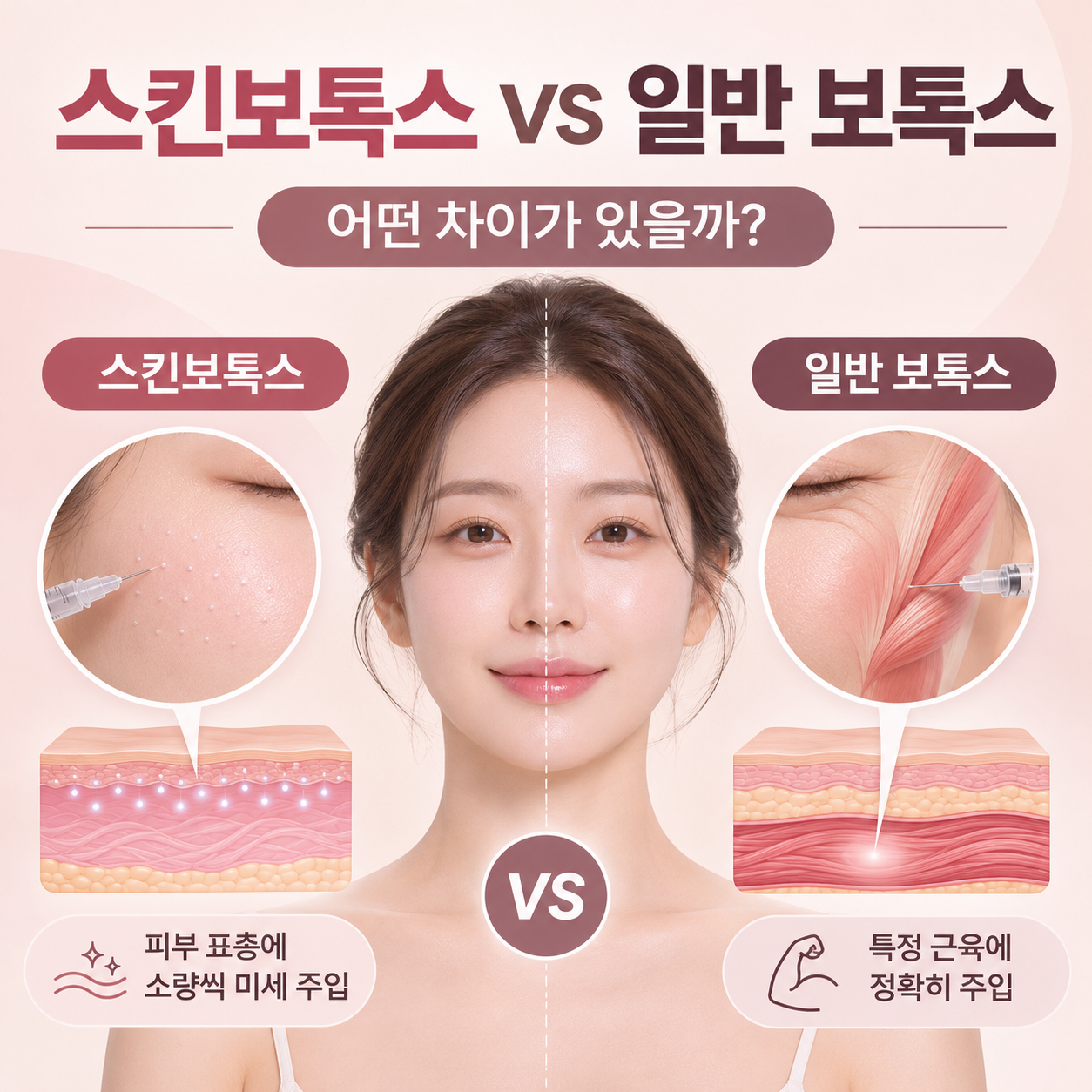
Injection Depth, Mechanism of Action, Expected Effects, and Treatment Precautions
Botox is a treatment that uses Botulinum Toxin to temporarily inhibit signal transmission between nerves and muscles.
It is mainly utilized to soften expression lines on areas such as the forehead, glabella, and around the eyes, and can also be applied to muscles like the masseter or calves depending on the treatment goal.
Recently, there has also been growing interest in Skin Botox, which differs from traditional muscle-targeted injections by delivering small doses of Botulinum Toxin into relatively shallow dermal layers.
While Skin Botox and standard Botox share the same active ingredient, they differ in injection depth, treatment goals, and expected outcomes.
Therefore, when comparing the two treatments, it is essential to first evaluate your skin condition and the areas requiring improvement, rather than simply deciding which method is inherently more effective.
01. How Does Botox Work?
"Botox" is widely used as a general term for treatments utilizing Botulinum Toxin, though formulations from various manufacturers are used in clinical practice.
Botulinum Toxin temporarily reduces muscle contractions by inhibiting the release of the neurotransmitter acetylcholine at nerve endings.
Because facial expression muscles are connected to the skin, repetitive muscle contractions can lead to wrinkle formation.
When Botulinum Toxin is injected into the target muscle, muscle movement is reduced, which can soften wrinkles that appear when making facial expressions.
However, Botulinum Toxin does not directly replenish dermal collagen or repair damaged skin tissue.
Treatment results may vary depending on the product type, dosage, injection site, and individual muscle condition.
02. What Is Standard Botox?
Standard Botox is a method that primarily injects Botulinum Toxin into specific muscles to reduce muscle contractile force.
It is typically used in areas where wrinkles are formed by the movement of expression muscles, such as the forehead, glabella, and crow's feet.
Primary Applications of Standard Botox
① Forehead Wrinkle Improvement
It is used to soften horizontal lines formed by facial expressions by regulating the movement of the frontalis muscle used when raising the eyebrows.
② Glabellar Frown Line Improvement
It improves vertical frown lines between the eyebrows by reducing the contraction of muscles used when furrowing the brow.
③ Crow's Feet Improvement
It is utilized to soften dynamic wrinkles around the eyes that appear when smiling or squinting.
④ Jawline / Masseter Muscle Improvement
If the masseter muscle is enlarged, reducing muscle activity can help induce a change in muscle volume.
However, because not all square jaws are caused by muscle bulk, the skeletal structure, adipose tissue, and skin laxity should be evaluated together.
Key Characteristics of Standard Botox
Standard Botox focuses on reducing excessive movement of facial expression muscles.
Therefore, it can be suitable for dynamic wrinkles that become pronounced when making facial expressions.
On the other hand, deep wrinkles that remain visible even at rest involve reduced skin elasticity and structural tissue changes, so they may not sufficiently improve with Botox alone.
03. What Is Skin Botox?
Skin Botox is a technique in which Botulinum Toxin is distributed in micro-doses into relatively shallow layers of the skin.
It is also commonly known by names such as "Dermotoxin" or "Microbotox."
While standard Botox focuses on decreasing contractions of specific muscles, Skin Botox is used for superficial fine lines, skin texture, and sebum secretion changes.
The action of Skin Botox is believed to be associated with modulation of dermal nerve endings, sweat glands, and nearby fine muscular fibers.
Some studies have observed improvements in surface oiliness, pore visibility, and fine wrinkles; however, these outcomes vary by product and injection technique, and clinical evidence remains limited in certain areas.
Key Features of Skin Botox
Dispersed micro-injections into relatively shallow dermal layers
Utilized for subtle, broad-area skin adjustments
Potential improvement in superficial fine wrinkles and skin texture
Potential changes in sebum secretion and pore prominence
Effects and duration differ from deep muscle injection approaches
If the injected solution diffuses into deeper muscular layers, Skin Botox can also affect underlying muscle movements.
Consequently, delivering injections into the skin layer does not entirely eliminate the risk of altered facial expressions.
04. Differences Between Skin Botox and Standard Botox
Category | Standard Botox | Skin Botox |
|---|---|---|
Main Ingredient | Botulinum Toxin | Botulinum Toxin |
Primary Injection Depth | Target muscles such as expression muscles | Primarily shallow intradermal layers |
Injection Method | Targeted injection per muscle | Dispersed micro-injections |
Primary Objective | Reduction of muscle contraction | Subtle superficial skin improvements |
Pores and Sebum | Not a direct primary target | Potential improvement reported in some studies |
Duration of Effect | Typically several months | Typically several months; evidence is limited |
Key Considerations | Muscle anatomy and dynamic movement | Skin thickness, injected volume, and diffusion range |
05. Which Skin Concerns Can Skin Botox Address?
① Superficial Fine Wrinkles
As skin ages, collagen decreases and elasticity declines, leading to fine wrinkles.
Skin Botox can be used to soften certain fine lines by modulating micro-muscular activity near the skin surface.
However, it does not physically fill or erase deeper wrinkles formed through long-term skin aging.
② Oily Skin with Excessive Sebum Secretion
When small amounts of Botulinum Toxin are injected into the dermis, reduced sebum excretion may be observed in some patients.
This effect is presumed to be linked to modulation of neural signals around sebaceous glands.
However, the exact mechanism is not yet fully elucidated, and the effect is not universally identical across all oily skin types.
③ Skin with Prominent Pores
Pore size is influenced by sebum output, follicular structure, and skin elasticity.
In some clinical studies, Skin Botox was associated with less noticeable pores alongside decreased sebum production.
However, it does not permanently shrink pore anatomy; if enlarged pores are driven by loss of elasticity or scarring, other treatments may be required.
④ Uneven Skin Texture
Skin Botox is also used to help the skin surface appear smoother by influencing surface fine wrinkles and oil balance.
Nevertheless, clinical studies on texture improvement are relatively small-scale, and further research is necessary to establish generalized therapeutic efficacy.
06. Does Skin Botox Look More Natural Than Standard Botox?
Because Skin Botox is injected in tiny amounts across shallow layers, its goal can be to induce superficial skin refinement while preserving muscular mobility as much as possible.
However, it cannot be asserted that Skin Botox is unconditionally more natural or safer than standard Botox.
If the injection depth and dosage are inappropriate, the medication may spread to surrounding muscles, potentially leading to facial asymmetry or restricted movement.
Conversely, standard Botox can also achieve wrinkle softening while preserving natural facial expressions when the target muscles and dosages are precisely calibrated.
Therefore, natural treatment outcomes depend more on a customized treatment plan tailored to your facial muscle anatomy and expression habits than on the injection technique alone.
07. When Do the Effects of Skin Botox and Standard Botox Appear?
The effects of Botulinum Toxin typically become noticeable after a certain period rather than immediately following the treatment.
With standard Botox, changes in muscle movement may begin within several days, and effects often become more prominent over 1 to 2 weeks.
With Skin Botox, visible skin changes can also be observed over several days to a few weeks, depending on individual skin condition.
Regarding duration, standard Botox commonly lasts approximately 3 to 4 months, while Skin Botox is often reported to last around 2 to 3 months.
However, these durations are not fixed.
Outcomes vary depending on the product brand, dosage, injection site, individual metabolic rate, and muscle activity.
Furthermore, because research findings and duration for Skin Botox's sebum and pore improvements differ across studies, it is difficult to offer a uniform maintenance period.
08. Can Skin Botox and Standard Botox Be Performed Together?
When superficial fine wrinkles and excessive muscle movement are both present, combining the two injection approaches can be considered.
For example, if deep forehead expression lines coexist with uneven skin texture and surface lines, a treatment plan can be designed addressing each underlying cause.
However, because both techniques utilize Botulinum Toxin, total administered dosage and diffusion area must be strictly taken into account.
In particular, repeated injections in the same area may cause unintended muscle weakness or facial expression stiffness.
Therefore, deciding on combination therapy should not be done merely to amplify effects, but after evaluating the underlying indications and potential risks.
09. Side Effects of Skin Botox and Standard Botox
Because both treatments deliver medication via needle injections, temporary skin reactions and Botulinum Toxin-related adverse events can occur.
Common Potential Reactions
Erythema and swelling at the injection site
Temporary pain and tenderness
Bruising and petechiae
Temporary headache
Small bumps (wheals) at the injection points
Adverse Reactions Requiring Attention
Ptosis of the eyelids or eyebrows
Asymmetry of the mouth corners when smiling
Excessive weakness of expression muscles
Uneven skin surface appearance
Functional discomfort caused by muscle weakness
Although extremely rare, Botulinum Toxin can affect unintended areas, potentially causing generalized muscle weakness, dysphagia (difficulty swallowing), or dyspnea (difficulty breathing).
If any of these symptoms develop, seek prompt medical care from a healthcare facility.
In particular, if you have a neuromuscular disorder or are taking related medications, you must inform your medical team prior to treatment.
Visit the Official TING CLINIC Blog
This content is for general medical information and does not replace diagnosis or treatment. Treatment effects and side effects may vary, so consult a medical professional.