Booster
Manual Injections vs. Mirajet: What Are the Differences Depending on the Skin Booster Injection Method?
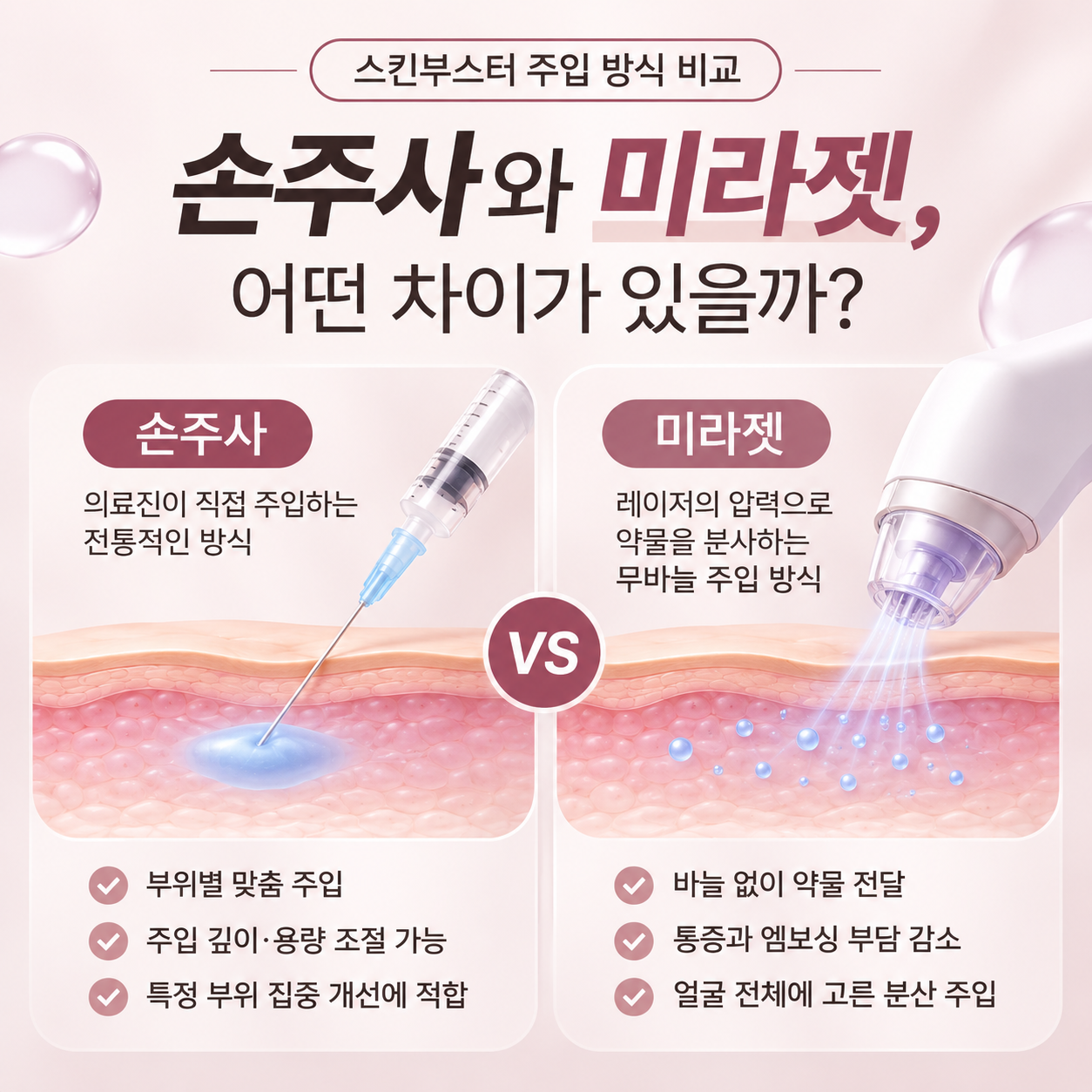
Manual injection is a method where the medical team directly adjusts the depth and volume of the drug, whereas Mirajet is a needle-free drug delivery method that utilizes the physical pressure of a laser. Mirajet can help reduce concerns regarding pain and embossing, while manual injection is useful for intensive delivery into specific targeted areas. It is important to select an injection method suited to the ingredients of the skin booster and your individual skin condition.
01. Why Is the Injection Method Important for Skin Boosters?
Our skin is composed of layers including the epidermis, dermis, and subcutaneous fat.
A skin booster is a treatment designed to improve the skin environment by delivering active ingredients to appropriate levels within the skin according to product-specific characteristics.
At this time, factors that need to be considered include the following:
Injection depth of the drug
Injection volume per area
Distribution and uniformity of the drug
Skin thickness and sensitivity
Treatment objectives and product characteristics
Even when using the same product, the appropriate treatment method may differ depending on these factors.
Therefore, when selecting a skin booster, it is important to consider not only the ingredients but also the injection method.
02. What Is Manual Injection?
Manual injection is a technique where the medical team directly uses a syringe and needle to inject the drug into the skin.
Its key characteristic is the ability to adjust the injection depth and volume for each area while assessing the condition of the skin.
Advantages of Manual Injections
Precise adjustment of injection depth tailored to skin conditions
Customizable injection volume for each treatment area
Ability to perform focused injections on specific skin concern areas
Applicable to injectable products of diverse formulations
It can be particularly useful when targeted improvement is needed for specific areas rather than uniform treatment across the entire face.
Disadvantages of Manual Injections
Pain from repeated needle punctures
Potential for post-treatment bruising or swelling
Potential for embossing (raised bumps)
Increased procedure time depending on the size of the treatment area
Variations depending on the injection technique of the medical team
For individuals with sensitive skin or a fear of needles, this process may feel burdensome.
03. What Is Mirajet?
Mirajet is a medical device that delivers drugs into the skin without needles, utilizing physical pressure generated by a laser.
Instead of applying direct thermal energy to the skin like standard laser treatments, it converts laser energy into the pressure required for jet dispensing of the drug.
Operating Mechanism of Mirajet
A 2,940nm Er:YAG laser irradiates liquid inside the device.
The laser energy creates instantaneous physical pressure.
Using this generated pressure, the drug is sprayed in ultra-high-speed micro-jets.
Fine drug particles pass through the skin and are delivered into internal tissues.
This is known as Laser-Induced Microjet technology.
Because it repeatedly dispenses small amounts of drug without needles, it can be utilized to distribute and deliver the drug evenly across a broad treatment area.
04. Characteristics, Advantages, and Limitations of Mirajet
Advantages of Mirajet
First, reduced burden regarding needle puncture
Because it does not use injection needles, the burden associated with repeated needle insertions can be reduced.
Second, fine and repetitive drug delivery
By repeatedly delivering small amounts of medication to multiple points, it can be utilized with the goal of distributing the drug evenly across the entire face.
Third, reduced burden of pain
Some clinical studies have reported lower levels of pain during the procedure compared to traditional manual injections.
However, the degree of pain may vary depending on individual sensitivity, the treatment area, and the product used.
Fourth, reduced burden regarding recovery periods
It can help lessen concerns such as bruising or embossing caused by needle puncture, making it an option to consider for those who require a prompt return to daily activities.
Limitations of Mirajet
Mirajet cannot replace every manual injection procedure.
Its application may be restricted depending on the viscosity and particle size of the drug and the purpose of injection, and some liquid may remain on the skin surface.
When a set volume of medication must be delivered intensively to a specific depth, manual injection may be more suitable.
Furthermore, even though needles are not used, reactions such as redness, swelling, petechiae, and pain may still occur.
05. Comparison of Differences Between Manual Injection and Mirajet
Category | Manual Injection | Mirajet |
|---|---|---|
Delivery Method | Hypodermic needle | Laser-induced micro-jet |
Injection Depth | Directly adjusted by the medical team | Varies by device settings and skin characteristics |
Drug Distribution | Targeted, intensive injection per area possible | Fine, repetitive dispersed injection |
Pain | Pain associated with needle insertion and drug delivery | Relatively low |
Embossing (Raised bumps) | May occur | Minimal / rarely occurs |
Bruising / Swelling | May occur | May occur |
Key Characteristic | Customized injection for specific areas | Even distribution across broad areas |
06. Why Does Mirajet Result in Less Embossing?
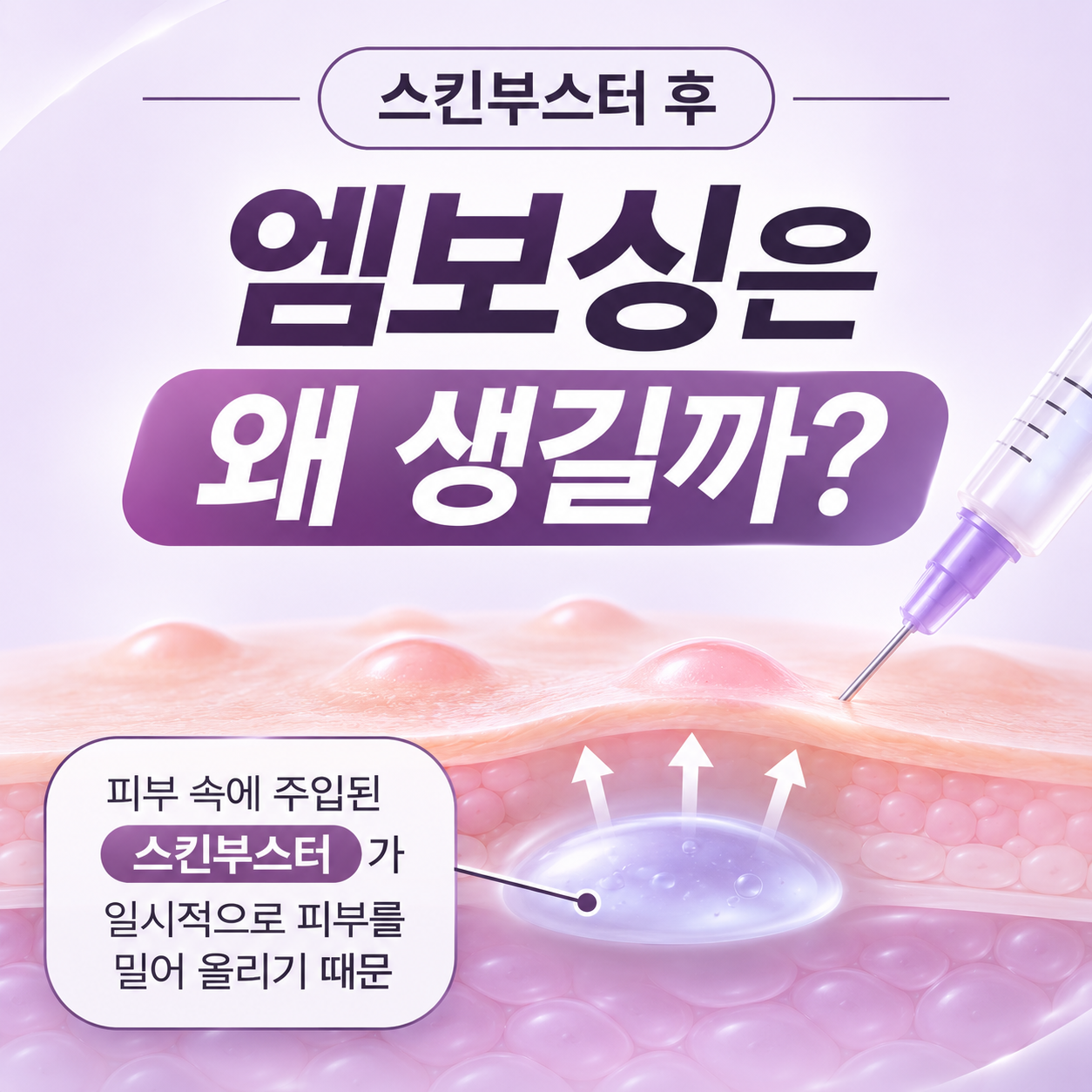
The bumpy, raised texture on the skin surface following a skin booster treatment is referred to as embossing.
When a drug is injected into superficial skin layers via manual injection, a certain amount gathers at a single point, which can cause the skin to temporarily raise.
In contrast, Mirajet delivers minute amounts of the drug split across numerous points, so noticeable embossing tends to be relatively minimal.
However, the presence or absence of embossing is not an absolute standard for assessing the efficacy of a skin booster.
Extensive embossing does not necessarily mean the drug was delivered effectively, nor does an absence of embossing indicate a lack of effect.
07. Is There a Difference in Results Between Manual Injections and Mirajet?
This is a question asked by many patients.
In a comparative clinical study published in 2023, where a product based on poly-D,L-lactic acid and hyaluronic acid was injected via manual injection and laser-induced microjet, both methods demonstrated comparable improvements in skin hydration and elasticity, with the microjet method showing less pain and fewer adverse reactions.
However, these research findings cannot be universally applied to every skin booster.
This is because different skin boosters have distinct ingredients, mechanisms of action, and optimal injection layers.
Ultimately, what matters is not that a particular delivery method is unconditionally superior, but rather selecting the approach best suited to the characteristics of the product and the goals of your treatment.
08. Which Skin Booster Delivery Method Is Right for Me?
When Manual Injections May Be Considered
Those requiring intensive treatment in specific areas
Those needing site-specific control over injection depth and dosage
Those using products whose properties necessitate direct injection
Those looking to improve localized skin concerns
When Mirajet May Be Considered
Those with significant concerns or fear regarding injection needles
Those concerned about pain during skin booster treatments
Those wishing to minimize embossing or bruising
Those looking to care for overall facial texture and fine wrinkles
Those for whom an immediate return to daily activities is essential
Visit the Official TING CLINIC Blog
This content is for general medical information and does not replace diagnosis or treatment. Treatment effects and side effects may vary, so consult a medical professional.